Mar 23, 2011

The Secret Checklist you must follow to Claim & Merge Google Places Pages

Consistency of contact information (local phone number, business address & email address) is the key to claiming and merging separate Google Places Pages. Ensure that you have this contact information included somewhere on your site as well, and check to make sure that it appears as crawlable text.

If you are trying to claim a very content rich Places page, Google ads in an additional identity confirmation hoop for you to jump through: the phone number listed on your sites WHOIS  page.
In short, the equation for claiming Places pages is:

Website address +  crawlable phone number on contact us page = mailing address submitted to places page  +  phone number you submit to places = your actual phone number & mailing address at the business = the phone number that appears in your WHOIS website profile. Mind the email you use as well.

Dec 1, 2010

It's in Google's best interest to charge bad site's more for PPC

A brief history of adwords pricing

In the old days, Google use to price your ads based on how much money your ads made for them. This meant that ads which were clicked on the most, were the cheapest. It was basically CTR X CPC = ad ranking (click through rate multiplied by cost per click in case you are new to ppc jargon). That’s not the exact formula; but it started off very similar to that. Then as Google evolved, the algorithm they used to determine ad rankings evolved as well.

But the biggest change happened a year ago, when Google introduced their landing page quality score algorithm. Google showed no mercy to websites that didn’t provide relevant landing pages to the users querry. Many people logged onto their adword accounts one morning to discover that their average CPC increased 500%. In extreme cases with sites practicing arbitrage; there were instances of the average CPC going from $0.25 to $5.44. It was a bad time for many – lots of people went out of businesses never having fully understood why.

This marked an important moment in the history of internet advertising. Before, the trick to increasing sales was by driving more traffic to your site. Now, internet marketers are more interested in increasing sales to their existing traffic.

Google is smarter than you or me First, you must understand that there is no fooling Google. You can’t fool Google with SEO like you could in the old days, it is just to smart for that.

No one understands the components of a profitable website like the programmers at Google. For one, they are really really smart people. But also, they cheat. They have inexhaustible data to look at from Google analytics and other programs. Marketing is science, not art. And the landing page algorithm is programmed to recognize the best marketed ‘landing pages’

How Google currently determines CPC (no math, just theory)

Google is all about the user. Therefore, if someone clicks on a PPC ad because they are interested in buying something; Google is going to damn well make sure that the website they land on sells what they want. More than that, Google wants to deliver the internet browser to the most relevant e-commerce site that has the best chance of selling you something.

People click on PPC ads because they are interested in making a purchase ( I’m keeping this discussion to products for simplicity sake). So the most relevant matches, the ones Google strives to deliver first to browsers, are the websites that are marketed the best and generally have the highest conversion rates.

How does Google make sure that the best marketed, highest conversion rate, websites always appear first? They give them a crazy discount! This is capitalism at its finest folks. The wealthiest internet companies pay the lowest price for ppc ads (lowest CPC) and the poorest internet companies pay the most for advertising (highest CPC).

You either make no money or become rich with adwords

If you don’t know how to sell your products well, if you suck at online marketing: Google will squeeze you like a tube of toothpaste and brush its teeth with your love. You will be paying 10 times more for an advertisement that works a tenth as well as your competitor. You are exponentially screwed! Your return on investment will 1/100 as sharp as the industry leader.

What does that mean for the industry leader? If you make $100 a month net from adwords – the industry leader is making over $10,000 a month. Sorry man.

Can you get cheap PPC ads anymore? Certainly. The internet is a backwards place; and most online niches really don’t have an ‘industry leader’. Just get a high quality score :-"

Nov 20, 2010

Making it easier for senior citizen's to christmas shop online

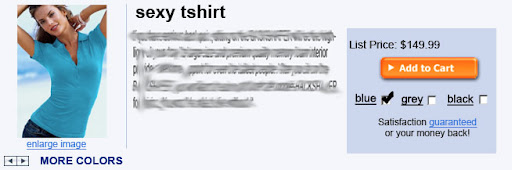
I had a good idea how to handle the color selection attribute when selling products. It doesn’t work with products where there are multiple options (i.e. sizes and colors), it is really just limited to products with only a few options.


A more ergonomic design for color selection

This type of color selection attribute is superior as far as usability design goes. You have two options for changing the product color: 1. press the arrows below the ‘enlarge image’ link or 2. click a check box below the ‘add to cart’ button. Note: if you change the product color by pressing the arrow buttons, the check boxes will change accordingly. This type of redundant selection system is intuitive and obvious to even the most computer illiterate customer – also, it should be easy to run for older browsers.

Its easy to take your computer skills for granted; but many potential customers – particularly elderly ones with lots of disposable income – have to struggle to understand basic computer applications. Seriously, you would be surprised how many people have to write down, on a piece of paper, how to do simple things like log into their email (with step 1 being turn on the computer). Respect this affluent demographic! There are millionaires that call tech support because they can’t figure out how to attach a file to their email and I have heard stories about people using their cdrom drives as cup holders. – These people do exist and they aren’t stupid, just computer illiterate (with lots of disposable income).


The main problem with most attribute systems is their dependence on drop-down menus. Drop-down menu’s are a lot harder to use than you think. A 2003 research study conducted at the University of Maryland by Ben Shneiderman, Ph.D. observes that some elderly users don’t know how to use drop-downs – making your site a struggle. Apparently even savvy users encounter usability problems, as a drop down menu requires an extra click and thus slows down persuasive momentum. Here is the usability guidelines report [PDF].

Drop-downs also will make your user pissed off. For one, they reduce the transparency of your product options, making learning about a product a chore - this will turn into an alienating and frustrating experience for disabled customers lacking fine mouse coordination. Think about it, have you ever had a drop down close on you before being able to select an option? Well multiply that frustration by a 1,000 if you want to imagine what it must be like for someone who has trouble aiming the mouse. If another usability problem immediately manifests – such as your customer accidentally changing the drop-down selection with the mouse scroll wheel - their frustration will be multiplied even more. Even if your customer doesn’t bail on your site at this point – their trust and confidence in your business will be burst. And lack of trust is a notorious killer of online sales, especially with computer illiterate demographics.

Do you sell a product that could benefit from this attribute system?

Jun 22, 2010

Suggestion's for a local online businesses product page

I wrote a review of this ecommerce site a while back but neglected to post the before shot of the site.


original website before review

Original wepage before I reviewed it


suggested changes to site
Here is a frankensteined suggestion of how to change the content and the layout of the same page

May 19, 2010

Shredding document's does NOT prevent Identity Theft

The vast majority of computer Viruses will rob your pocket. Whether they steal the login details for your online banking website; record your credit card info when you make an online purchase, or just plain out scour your emails for personal info - they get the job done cheaply and safely for identity thieves.

It's worth noting though that The amount of money criminals are making from online consumer fraud is growing in volume every month and in double digit numbers. Though it's probably an underestimate, criminals made at least $120 Million during October, November, and December of 2009.

So don't stress about shredding everything you thow out . Stress about whether your computer has a virus or not instead.

May 13, 2009

Google Take's Frustration out of Searching by Date

Nothing used to be more annoying than using the date filter search on an average size computer screen.

First you had to select the date from the dropdown; then you had to click on the white screen foreground so that you could use your scroll wheel without resetting the dropdown; and then, finally, you could scroll to the bottom of the page and click the long awaited 'advanced search' button.


OLD way of searching by date's: Observe how the poor usability and bad economy of motion (due to extrenous clicks) make's you a die a little bit in side.


New way of searching by date's: Truly, it is so easy that it doesn't qualify as an 'advanced search' any longer.

Aug 23, 2008

Google is starting to price ads like the NYSE does stocks

Now all we need is a stock ticker below each adgroup telling us the real time 'quality scores of every ad. What is amazing about this algorithm update is that it is a first step for Google to improve consumer confidence in Pay per click and git rid of SEO charlatan's. Whats going to happen to their share price when the demand for pay per click ad space goes up?

Say hello to double digit ad prices :)

read more | digg story

Dec 21, 2007

How to Rock your Conversion Rate with high contrast buttons


Your a smart cookie; you know that using buttons for your 'add to cart' and 'checkout' navigation will increase conversions. It's just a fact - people are more likely to click on a button than they are a hyperlink.

But not all buttons are created equally. Are you aware that on most websites, red buttons will usually convert more online traffic than blue buttons? This has nothing to do with the colour red; rather it's owed to the fact that high contrasting buttons are more easily seen and have higher CTR's. Thus, for a pink website, a blue button would be the better choice. Pretty straightforward stuff.
But there is one rule you must follow to prevent an aesthetic nightmare and benefit from better buttons.

How to rock your conversion rate with high contrast buttons
The first thing to do is use them sparingly. Personally, I like using bright red buttons for the key navigation steps that lead to a sale i.e. the "add to cart" button "checkout" buttons. These are the actions you want your visitor's to take. For actions you don't want your customers to take, but still warrant a button, a more diffused version of your high contrast button or perhaps a neutral grey button would be the ideal choice.


The right way to mix two button schemes
The emphasis here is for people to press the checkout button. "continue shopping", 'delete' and 'update' are less likely to earn you a sale; thus, they remain subservient to the site design.


The Wrong way
Not only is this an aesthetic nightmare, but you are promoting actions you don't want people to take, like pressing the "delete" button.

Sep 9, 2007

Google is going to kick aside Timewarner like they were a mom and pop shop.


It's nice to see that Google has held steadfast to their goal of becoming the mother of all monopolies. But after reading leading SEO expert, Bill Slawski's analysis of GPAY, it dawned on me that we are only five years away from Google being hand over fist the biggest bank in the world.

Basically, GPAY is going to allow you to use your cell phone as
1) a digital credit cart that will be accepted anywhere plastic credit cards currently are today (no need to worry about that pesky waitress taking more than a carbon copy anymore )
2) a way to make off line purchases through your cell phone (lets say you want to buy a sweater from a catalog, you just type in the 7 digit text message/authorization approval code into your cell phone and Voila! Google charges your credit card, pays the company selling the sweater and gives them your billing address. Sweet!)
3) A convenient way to pay parking meters, buy soda from vending machines etc.. without having to burden yourself with small change.
4) Even strippers will benefit since this digital credit card will work (undoubtedly) in ATM machine's as well.


I'm excited because this is going to mark the dawn of a new era in e-commerce. No longer will e-commerce be confined to just internet advertising . Commercials; magazine ad's, newspaper ad's, even billboards will all be fair game now. Likewise, catalog companies and infomercial campaigns will be able to rake in more money as well (and cut down on telemarketing), if they can negotiate the e-commerce arena with some grace. As I've predicted before though, Google and Yahoo will likely have a duopoly on all e-commerce at that point.
This will probably be the biggest boost to the US economy since the advent of e-commerce in the 90's.


I will bet you one share of Google stock, that within 7 years of now, Google will have a public approval rating (in the USA) significantly higher than any president in the history of this country.
Your going to love what Google does for you, I guarantee it.


1)Kiss your cell phone bill, your house phone bill, those damn surcharges for text messaging, long distance charges to Tokyo, and your broadband/dsl bill farewell. That is an extra $200 a month; probably one of the bigger tax breaks for your average American. Google is going to setup a worldwide infrastructure that will give everyone free broadband access. This has been rumored for some time now, and given all that is at stake, Google can't Afford NOT to give the world free phone and broadband. The profits from all the increased cell phone advertising, offline advertising, and associated credit card processing would justify financing this endeavor easily.

When Google pulls this off, they are going to be in the perfect position to make GPAY the most commonly use credit card in the world. I'll be eating popcorn and watching CNN (or youtube probably) when that day happens. The road to hell is paved with good intentions, and right now, Google is a moral and ethical company. Never have I seen a 10,000 pound gorilla so well behaved. I have faith that the masterminds running Google will take every step conceivable so that the company will never sway ethically from their corporate philosophy. I think that Google's management finds the thought of their offices being corrupt reprehensible.
Honestly, they remind me of our nation's forefather's.


Jun 19, 2007

Where's the marketing message?

They say that with websites; you have 8 seconds to capture the readers attention before they bail. 8 seconds to display a pull-based marketing message.

But for push based marketing: whether an ad on a bus bench, something in the paper, or my case, the ad on the back of a movie stub – you don’t have the luxury of 8 seconds. 8 seconds is an eternity to look at a billboard when driving, or an ad on a matchbook cover. You really only have a second, maybe 2 if you are lucky. So its best to keep the message you send short, and sweet. No glitzy stuff.

That is not what AMC theaters did when advertising private movie screenings for events on the back of their tickets. I had this ticket stub lying around my apartment for months, maybe years. It kept on showing up, I saw the back of it a gazillion times. Every time I saw it, I only gave it a second of my time – long enough to read ‘VIP’ and then lose interest. It wasn’t until last week that I, for some unknown reason, read the entire ad. I had no idea that one could show theater movies at private parties and events. How cool is that?


Look at the back of the stub yourself – a lot of stuff to read, huh? Between the fancy shmancy image, the logo, the extraneous VIP headline – there is no way a customer can read and digest the advertising message in 1 second.


The back of a movie stub

But, what if AMC just had a short line of text on the back of their tickets; accompanied by the relevant contact information. They wouldn’t be selling anything, they would just be informing prospective customers of a service. They could have had my business – had I known.


How I would have done it

Don’t bullshit customers

Learn about the breakthrough marketing secret created by neuroscience! Yes, make millions of dollars without even trying. This system is fool proof! Ask Sherry Ann who made 9 billion dollars within a day of purchasing our system. Its that easy!

Okay, most of you probably figured out that the above was complete bullshit. But who honestly has never seen this type of copy before? Sure it works sometimes. A sucker is born every minutes; so the ancient adage goes. But most consumers are not suckers – and treating them as such will lose you a sale.

Consider this: displaying negative customer reviews (testimonials) on you website can increase sales – according to several marketing case studies. Why? Because people want to read authentic customer testimonials – not advertising. And by displaying the occasional negative customer review, you are proving the veracity of your advertising. You are proving that you speak the truth.

Personally, I think the younger generations are better at detecting bullshit than older one’s. That is because younger generations have grown up in a world more saturated with advertising – they are more trained to zone out bullshit. Take the above video. Probably a joke by some kids.

May 16, 2007

How adding usability can create marketing relevance

You may have heard: vertical businesses are the new trend for e-commerce - thanks to their natural advantage in niche marketing. While a large scope, horizontal, business can do anything a small vertical can – it is much more SEO/marketing intensive.

The new horizontal stores I see these days always have one thing in common: a lack of relevant content for both browsers and Google. In the past, when metatags were more important, these stores performed well in the search engines. And at the time, they were relevant to what the users wanted.

But as the internet continuously grows; Google continuously finds new ways of identifying the most relevant content for its users. Relevance by itself is not enough for your business to succeed these days – you must be able to communicate that relevance at faster than light. For this reason, it is imperative you match your navigation, titles, and page headlines exactly with what the visitor is searching for.

Sites like this have no chance of advertising via Google anymore - not even for PPC advertising. Why? It is just a laundry list of products; none being named after keywords users are typing in.


How many people do you think are typing in the category headline: ' Skin & body cosmetics'?

Answer: 0

How about the headline on the product page: Indulona Antibacterial

Answer:0


The 800+ customers searching for 'anti aging cream' everyday will never find this store through google; even though, they sell that exact product. Too bad this store didn't conduct any keyword research when planning their information architecture :(


What if your information architecture is just to vast? Well, in that case, I recommend adding another navigation scheme:


Now we have two navigation schemes. 1) clicking on the product names to the left 2) browsing through the category image pages. Remember, different users browse in different ways, take a look at Victoria Secret's website if you want elaboration.

Aside from increasing usability; this type of category page gives you more marketing latitude and opens up the doorway to countless niche markets. In addition, Search engine marketing, and PPC marketing are once again possible to compete in.

Example of a landing page that exploits a new marketing niche

For that brave spammer out there who has sent me 5 billion unsolicited Viagra emails in the past 10 months. You will be part of my spam box always…


Unfortunately, I don’t think my spammer friend ever achieved the 0.00036% conversion rate typical of SPAM email. Considering a competitor using PPC advertising would convert traffic ten to hundred thousand times better than him: does he even have a chance of breaking into the industry? The answer is no. The only businesses that profit from Spam are the bulk email companies peddling it.

Is there any chance for an underdog to compete in the online Viagra market? After all, several hundreds of companies compete over the keywords of Viagra and erectile dysfunction. That online niche is completely filled to capacity.

To find a new online niche for Viagra; it will be necessary to uncover a traffic stream with needs that are met by the benefits of Viagra. To find such a traffic stream: conduct some keyword research and scrutinize the different keyword phrases being Googled.

Keyword Research for Viagra

Current niches

  • Viagra ~ 1.4 million
  • Erectile dysfunction ~ 350k

Untapped niche markets

  • Making love ~ 200k
  • Kama Sutra ~ 1 million
  • Sex position ~ 500K

Next step is creating a relevant landing page for each of these search terms. We are going to illustrate this with the keyword ‘Kama Sutra’. Although Viagra may not be a relevant product to everyone searching for 'Kama Sutra’; the non existent PPC demand for this keyword means dirt cheap advertising and a superior ROI.

Want Unforgettable Sex?
Enjoy Discount Viagra And Imbibe
In Sex That Eclipses Kama Sutra
www.blueponfar.com

Get unforgettable sex

Enjoy sex on a new plane and take Kama Sutra farther than ever before. Discounted Viagra empowers you for a new level of love so strong that it will burn itself into your memory.

Untapped marketing niches can be found everywhere on the net. Although it is hard for us to see right now; e-commerce is still in its adolescence and is immature when compared to conventional retail. After all, keywords are scarcer than even the trendiest retail stores.

May 9, 2007

I wish I read this article a year ago....

The Problem With Ecommerce: Don’t Build Your Own Ecommerce Engine
...... The reality is that it would take several man-years to even come close to matching the features that a mature ecommerce application would have.
This article could have saved me a lot of time. I honestly had no idea how difficult rewriting the core code of osCommerce is as I always thought that the real challenge behind designing the perfect site was in the usability and architecture - not the actual coding!

At least now I understand why the state of E-commerce on the web is so backwards. Finding experts in website usability design, online Marketing and Sales, and hardcore osCommerce coding is nearly impossible to do. It has taken about a year for me and all I had to do was find a kick-ass programmer!

I'm not sure if my e-commerce opus was worth the nightmare. While usability design is extremely important, it can only increase your sales linearly. Marketing & Sales are what give you the geometric increases in business. At least I will be getting an e-commerce site 4 generations ahead of my closest competition; compared to my site, they will look like the Taliban.


May 2, 2007

Google product search soon to seduce online businesses


Say hi to the future of e-commerce and finish your mother’s day shopping at the same time – here comes Google product search. The pieces on the chess board are almost in place. How long do you think it will take Google to align their product search, their checkout, and their various social networking sites? Not long - I guess I will be working for Google soon. :(


As an alternative, I can can choose Yahoo as an employment option - as what ever Google is doing, Yahoo is always a step behind. I mention the possibility of Google checkout and yahoo checkout becoming a best practice for PPC, in a marketing forum. I never thought this would be correct because the rules of e-commerce were changing.


All things considered, I think Google checkout and Yahoo checkout will soon dominate the internet for online transactions. In fact, objects are already in motion. Why else would Google checkout and yahoo checkout be offering free processing until 2008? Price wars are a rookie move – don’t think for a moment that Paypal and Google aren’t aware of the stakes they are playing for.

May 1, 2007

Don't make your customers think: use blue hyperlinks

Personally, I have always felt that when you choose your sites color scheme, the rule of thumb is to use blue hyperlinks. This is because blue hyperlinks have the highest click through rates. People are conditioned to recognize blue text as a hyperlink – there is no thinking involved, the recognition is immediate.

As Steve Krug said in his famous book - don’t make your customer’s think! While black hyperlinks are as widely recognized as blue hyperlinks – black hyperlinks take a few moments longer to recognize. Whether it is a split second, or several moments: any extra thinking you demand of your customer makes them less likely to trust you. Since lack of trust is a leading reason preventing online purchases, the answer is simple. Don’t make your customer’s think! Use underlined blue hyperlinks.

Apr 18, 2007

Creating hyperlinks that boost customer trust

When I was a neophyte to e-commerce; I remember monsterwebdesign telling me that that the best place for your privacy policy to appear is above the fold. But this practice is about as backwards as your Doctor using live leaches to clean an infected wound. Sure it might get the job done; but you aren’t going to win over your customer’s trust – that’s for sure.

By the way, the reason you need to make your policies readily available, is because many customer’s just don’t trust you. Whether it’s with giving you their email address or their credit card information; you need to reassure them. The solution to this problem is not displaying a laundry list of policies above the fold – but by providing the appropriate policy only when a concern becomes relevant.


Example 1) You are selling a product that has a money back guarantee - how should you inform your customer's of your return policy?

-----------------
which looks more professional and straightforward to you?


Example 2) You want to convince your customer that they are safe from being spammed if they give you their email address:

easy


Example 3) You want to assure your customer that it is safe to pay via credit card over the computer. You need to prove to them that some computer hacker living in Norway is not going to intercept their credit card information and then sell their identity online inorder to feed a crystal meth addiction.

easy


As far as dealing with customer concerns; relevant hyperlinks are the way to go. Mark my words, this will be a textbook part of web design in ten years.

Apr 14, 2007

Hacker safe logo only good for bad sites

I have been getting lots of questions recently regarding the significance of using a hacker safe logo. In short, a hacker safe logo will only boost your sales if you do a lousy job of reinforcing customer trust during the checkout.


And what signifies a bad site - in the context of hacker safe? If the 'https' found in your browser is the only clue that a purchase is secure.

If you want further elaboration, check out this post I wrote a few months ago.

Apr 6, 2007

Exploiting keyword research with relevant marketing

Pimping out low value keywords ain't easy. Finding them is though - all you need is a keyword research tool and a little due dilligence on Google. Once you identify a low competition keyword, with reasonable traffiic, think long and hard if there is any possible way for you to exploit it. Look for keywords that represent desire's or need which can be fullfilled by the benefits of your product. The less the demand for those keywords, the higher your ROI the more fun the challenge is.


For example lets say you are selling auto induction kits (700 keywords a month). Why would you want to compete in that kind of grind? Instead, create an ‘auto air filter’ landing page, and market to 3,600 keywords a month that there is less competition over. But wait, we can take it further still: consider the benefit to gas mileage auto air filters provide your car. Wow! Between gas mileage, mileage, and driving mileage – you have well over 50,000 searches a month. Yes, it is a test of your persuasiveness in constructing a landing page with scent trails – but you have so much to gain and so very little to lose.

Turning traffic into sales

“If you build it, they will come”. Unless you can go back in time to the 90’s, this is flat out wrong. For an e-business to succeed in today’s competitive business environment; you need to have more than just a laundry list of products listed in virtual space. You need products that fulfill a need – your marketing must add value. Easier said than done, right? Actually, it is nearly impossible to add value to a product through marketing alone. That is because there can be no distinction between sales and marketing in today’s e-commerce website.


The most common faux pas I see is when entrepreneurs design an online store, write great (or horrible) copy for each product, and then implement ppc advertising while hoping they will be the next Amazon.com. This is backwards marketing – both literally and figuratively.


Want to know what separates the boy’s from the men? Here is the secret. You figure out your advertising angles first, then you write relevant copy in the form of landing pages. While this is really just bringing relevancy, your most beloved Google will measure each landing page by quality score – so don’t skimp on any of the details.